






As data centres grow in complexity and criticality, so too does the process of ensuring their systems function as intended before going live. This is where data centre commissioning play a vital role.
In this article, we’ll explore the five levels of data centre commissioning and what this means for those working in testing and commissioning roles within the sector.
Contents
- What is data centre commissioning?
- Level 1 – Red tag
- Level 2 – Yellow tag
- Level 3 – Green tag
- Level 4 – Blue tag
- Level 5 – White tag
- Data centre commissioning jobs
What is data centre commissioning?
Data centre commissioning is a structured, multi-phase process that tests and validates all systems in a data centre—mechanical, electrical, IT, and security—prior to handover.
While commissioning is relevant to many types of buildings, the process is especially rigorous in mission-critical environments like data centres, where uptime and reliability are paramount. From design verification to integrated systems testing, the commissioning process ensures that the facility performs as designed—and continues to do so after launch.
5 data centre commissioning levels
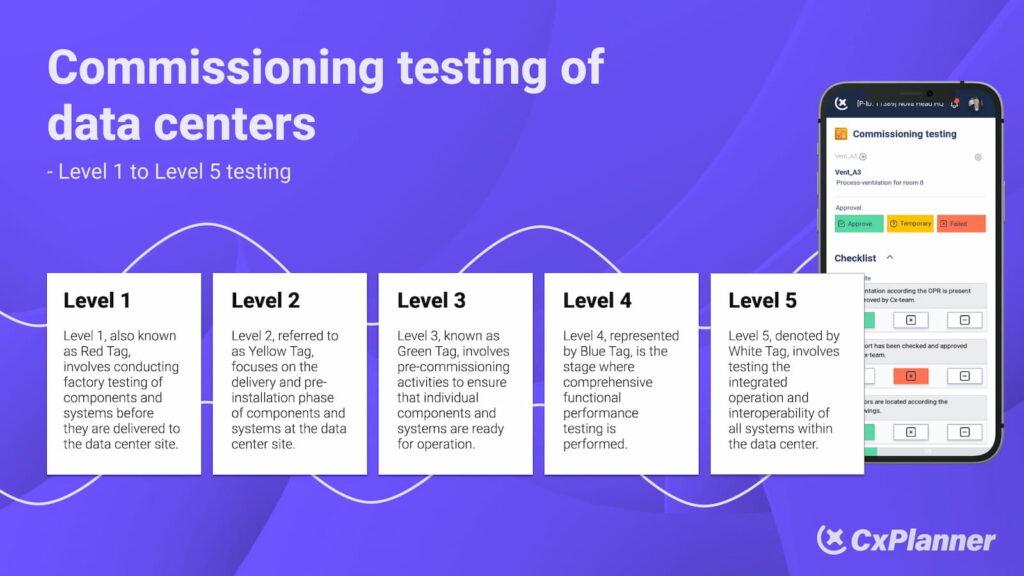
The data centre commissioning process is often broken down into five key levels, each representing a stage in the system validation lifecycle. These levels provide a framework for tracking progress and ensuring that all components—individually and collectively—meet performance and operational standards.
Level One: Factory Acceptance Testing (FAT) – Red Tag
Before equipment even reaches the construction site, it’s tested by the manufacturer to confirm that it meets the specified requirements. This includes equipment like generators, UPS systems, and chillers. Level 1 ensures that components function correctly before delivery.
Level 2: Site Acceptance and Installation Verification – Yellow Tag
Once the equipment arrives onsite, Level 2 focuses on installation checks. Are the units installed correctly? Are they in line with design drawings and safety codes? This level includes physical inspections and pre-functional checks, ensuring everything is ready for startup.
Level 3: Start-up and Pre-Functional Testing – Green Tag
At this stage, systems are powered up and tested individually to verify that they function in isolation. For example, an HVAC unit might be started up to confirm proper operation, without yet being integrated into the full control system.
Level 4: Functional Performance Testing – Blue Tag
Level 4 is more comprehensive. Here, systems are tested in sequence and under normal and failure conditions to ensure they function as intended. This level is critical in identifying how systems respond during simulated failures, such as loss of utility power.
Level 5: Integrated Systems Testing (IST) – White Tag
The final and most rigorous stage involves testing the entire infrastructure under full operational load. This simulates real-world scenarios and emergency events to ensure the whole system functions together. It’s the last step before handover to the operations team.
Data centre commissioning jobs
With data centre investment booming globally, testing and commissioning professionals are in high demand. These roles are critical in ensuring new facilities come online without costly delays or system failures. We recruit for both permanent and contract commissioning engineer roles across Europe and the USA.
Commissioning engineer salary
According to our 2024 Data Centre Salary Survey, Commissioning Engineers in permanent positions earn an average of £88,684 per year in the UK and Europe. In the United States, they earn an average of £111k.
Commissioning engineer day rate
Data from our survey suggested that the average day rate of a Commissioning Engineer in a contract role was £579. Commissioning Managers earn slightly more, at £693 per day.
This demand reflects the complexity of testing and commissioning in construction, especially in hyperscale environments where any downtime could result in millions lost in service disruptions.
The five levels of data centre commissioning provide a critical roadmap for delivering reliable, high-performance facilities. From factory testing to full system integration, each level ensures that the infrastructure can meet the demanding requirements of today’s digital economy.
Whether you’re a facilities manager, project stakeholder, or engineer exploring commissioning in construction, understanding these levels is key to delivering projects that are not only complete—but proven to perform.
If you’re a commissioning professional looking for new career opportunities in this field, get in touch with our specialist recruitment team.
Other insights
-
Is It Easy to Get a Data Center Commissioning Job? What Our Survey Says
Is it easy to get a data center commissioning job? 67% of US commissioning professionals say very or fairly easy. See what our 2026 survey found.
-
Data Center Commissioning 2026: USA
Download the 2026 USA Data Center Commissioning Survey. Insights on travel, expenses, career entry, and career progression from commissioning professionals.
-
Data Centre Employee Benefits: What Professionals Want in Europe and the US in 2026
Data centre employee benefits aren’t valued in the same way in every market. In our 2026 Data Centre Salary Survey, 30.3% of European respondents said they wanted equity in their package, while 38.1% of US respondents chose a car or fuel allowance. The findings show how different a competitive offer can look on either side…
-
Gender Pay Gap in Data Centres 2026: What Changes at a Senior Level
The gender pay gap in data centres isn’t experienced equally. In our 2026 Data Centre Salary Survey, 46.4% of women in Europe and 51.4% of women in the US said their gender had negatively affected their pay or career progression, compared with just 1.7% and 2.2% of men. For employers, the important question is where…
-
Visa joins award-winning Digital Futures Programme
Visa has joined the award-winning Digital Futures Programme as a School Partner at UTC Reading, helping students build the skills, confidence and industry insight needed for careers in technology and digital infrastructure. Through direct employer engagement, Visa will support real-world learning and help strengthen the future digital talent pipeline.
-
Data Centre Employee Retention: Why People Plan to Move
People might be planning their next move at similar rates across Europe and the US, but what’s driving them is very different. In our 2026 Data Centre Salary Survey, 35% of European respondents planning to move companies cited career development as their main reason, while in the US, 39.3% pointed to pay and other financial…


5,977 responses to “The 5 Data Centre Commissioning Levels”